Stevens Projects

Projects

A Quick Overview of what I built at Stevens

← Back to Home

Junior year

Junior

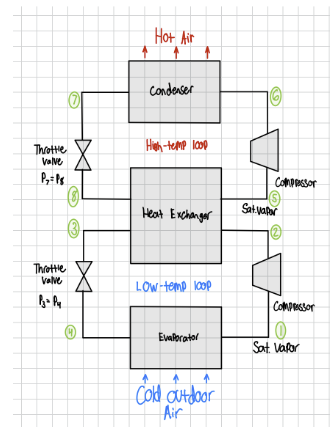
Cascade Heat Pump Design

Designed and optimized a two-stage (cascade) air-source heat pump to deliver 150 kW heating from 0°C outdoor air to a 25°C indoor setpoint.
Overview

  • Thermal design project comparing a conventional single-stage vapor-compression heat pump against a two-loop cascade configuration for large temperature lift.
  • Cascade architecture couples low- and high-temperature loops via an intermediate heat exchanger to reduce compressor work and improve COP.

My role

  • Owned the core calculations and parametric study; generated performance graphs and summarized results for the final report.
  • Evaluated operating point trade-offs and identified the intermediate pressure that maximizes COP while meeting the 150 kW load.

Tech

  • Thermodynamic modeling using refrigerant property tables + energy balances across compressors, heat exchangers, and throttling devices (idealized assumptions per spec).
  • Parametric sweep of intermediate pressure (3.2–6 bar) to balance compressor workloads and minimize total power.
  • Compared cascade vs single-loop: optimized cascade COP ≈ 8.61 vs single-loop COP ≈ 7.37.

Impact

  • Identified optimal intermediate pressure near 5 bar (max COP ≈ 8.61; total compressor power ≈ 17.43 kW for the 150 kW heating requirement).
  • Projected energy savings vs single-stage: ~2927 kWh/week (cascade) vs ~3240 kWh/week (single-loop) at constant load.
  • Economic analysis showed payback of the higher upfront cascade cost in ~3.1 years and materially lower lifetime cost (e.g., ~$85k lower over 20 years).
Sophomore year

Sophomore

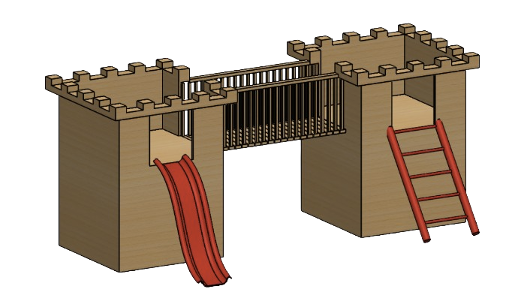
Playground Castle

Designed a medieval-themed backyard play structure (towers + bridge + slide + ladder + swing set) with safety-first engineering analysis.

Playground castle CAD rendering

Overview

  • Residential backyard play structure concept for kids ages 5–12: two towers connected by a bridge, with slide, ladder access, and a standalone swing set.
  • Designed to comply with ASTM F1148 safety standards and CPSC guidelines; material choices focused on durability and safe use.

My role

  • Owned the castle/bridge CAD design and integrated the structure into a cohesive SolidWorks assembly.
  • Performed key structural calcs (bridge L‑bracket shear + bridge railing axial loading) and built an Excel sheet to explore safety factors across variables.
  • Produced engineering drawings for the castle, bridge, slide, and ladder.

Tools / stack

  • SolidWorks (parts, assemblies, drawings) + Excel for load/safety-factor exploration.
  • Engineering analysis: axial loading, bending moments, shear loading, and factor-of-safety checks.

Results

  • Bridge designed and checked for a 4‑child load case (4×60 lb) with high safety margins (e.g., L‑bracket shear FoS ≈ 241).
  • Verified key fasteners/attachments with strong safety factors (e.g., slide bolt FoS ≈ 89) and documented compliance-driven dimensions (rail heights, spacing, etc.).
Sophomore

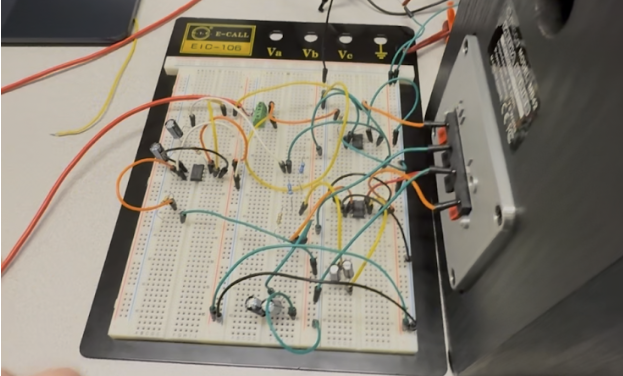
Audio Amplifier and 2-way Crossover Filter System

Designed and built an analog audio amplifier + 2‑way crossover (LPF/HPF) to split a mixed signal into clean low and high bands.

Overview

  • Built an audio amplifier and 2‑way crossover filter system to isolate low and high frequency content from a mixed input signal using analog hardware.
  • Target: ≥10 dB gain before filtering; achieved ~20 dB gain and clear band separation (validated in simulation and on breadboard).

My role

  • Co-built and debugged the full system (simulation → breadboard), including filter implementation, testing, and results analysis.
  • Helped validate design choices by comparing Simscape outputs against MATLAB FFT + digital filtering.

Tech

  • Non-inverting op-amp amplifier (~20 dB gain) feeding a 2‑way crossover: 2nd‑order LPF (Chebyshev, 160 Hz) + 2nd‑order HPF (Butterworth, 1.5 kHz) using Sallen‑Key topology.
  • Input frequencies identified via FFT: 58.32 Hz (low), 349.19 Hz (mid), 4698.71 Hz (high).
  • Added buffer stage after filtering to prevent loading errors while driving low-impedance speaker loads (~3.35–4 Ω).

Impact

  • Simscape model cleanly separated the bands; physical circuit matched closely despite component substitutions due to lab availability.
  • Analog and MATLAB digital filtering produced similar separation; noted digital output was cleaner under ideal conditions.

Freshman year

Freshman

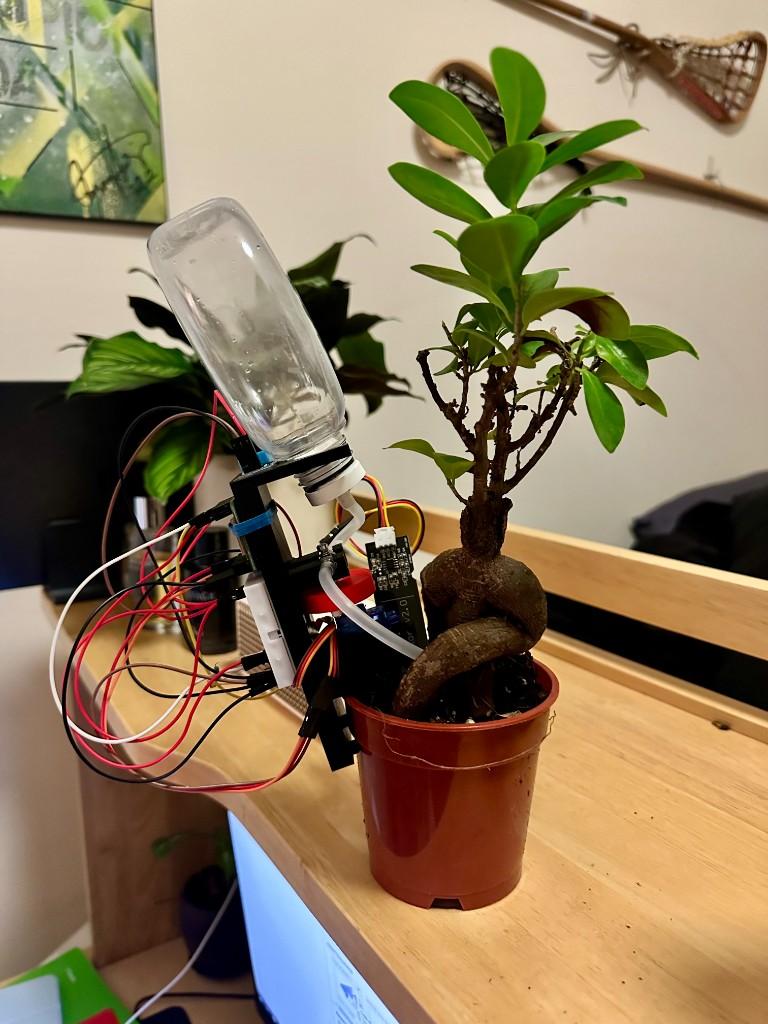
Automated Plant Watering Prototype

Built in the Stevens maker space — sensor-driven watering with a compact mechanical mount.

Automated plant watering prototype

Overview

  • Automated plant watering prototype that monitors environmental and soil conditions and actuates a valve to water only when needed.
  • Reads soil moisture + temperature/humidity + light; publishes sensor data to an MQTT server for monitoring.

My role

  • Mechanical lead: designed the full mount/enclosure in SolidWorks, iterated prototypes, and produced assembly + drawings.
  • Co-authored the report and coordinated mechanical integration with the electronics/firmware.

Tech

  • Arduino-based system with soil moisture sensor, DHT sensor (temperature/humidity), and a photocell (lux conversion).
  • Servo-motor actuates a valve via a 3D-printed adapter/fixture; threshold logic opens valve when soil moisture < 40%.
  • IoT logging: sensor readings serialized and published to MQTT (sampling every ~5 seconds).

Impact

  • Deployed in the Stevens Integration Lab (EAS 201) Dec 7–11; temperature + humidity readings were stable and expected.
  • End-to-end system successfully demonstrated: removing the soil sensor triggered valve open; in-soil readings kept the valve closed above threshold.
  • Identified a clear improvement area: photocell-to-lux conversion became unreliable during deployment and needs refinement.
Freshman

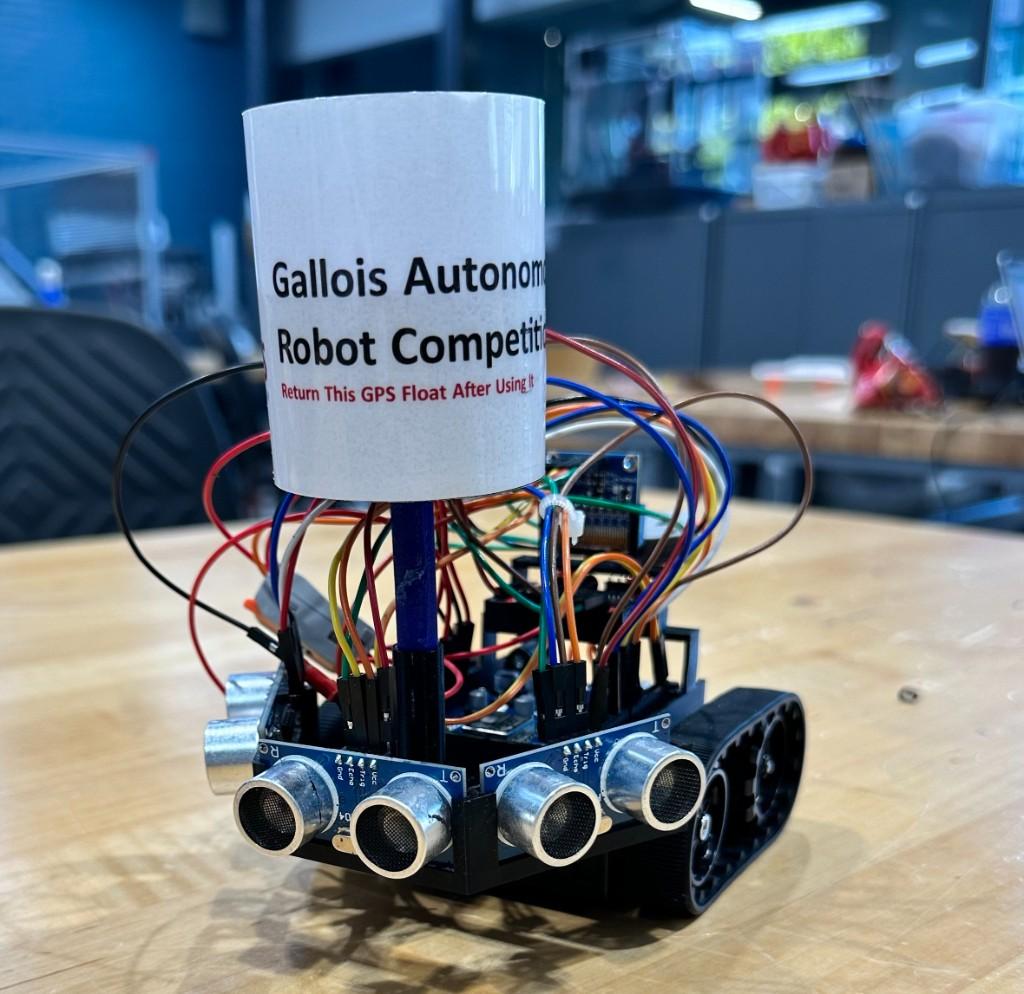
Autonomous Robot Build

Small mobile robot with sensors and embedded control — built for competition work.

Autonomous robot prototype on a workbench

Overview

  • Autonomous campus-tour prototype robot that navigates a miniature Stevens arena to reach 4 targets using live position coordinates from an MQTT network.
  • Designed to avoid obstacles (no collisions) and complete the course within a 3‑minute evaluation window.

My role

  • Mechanical design lead: developed and iterated the 3D‑printed chassis (concepts 1–5) to mount all required components cleanly and securely.
  • Owned mechanical documentation (wiring/assembly visuals) and contributed to system integration and testing.

Tech

  • WeMos D1R1 (ESP8266) + motor driver + battery pack; OLED displays group + live X/Y coordinates.
  • 3 ultrasonic sensors for obstacle avoidance; steering logic veers away on side detections and turns when front sensor triggers.
  • Path guidance from MQTT/LiDAR coordinate feed; progresses through target list when within ~140 units of a target.
  • Chassis met manufacturing constraints: printed in ~2h 40m (under the 2h 50m limit).

Impact

  • Final competition performance: best run reached 3 of 4 targets once; consistently reached 2 of 4 targets across multiple runs.
  • Obstacle avoidance was reliable (no collisions); main limitation was target pathfinding after the second target.
  • Identified improvement areas: better pathfinding algorithm + improved weight distribution (robot was front‑heavy on fast reverses).